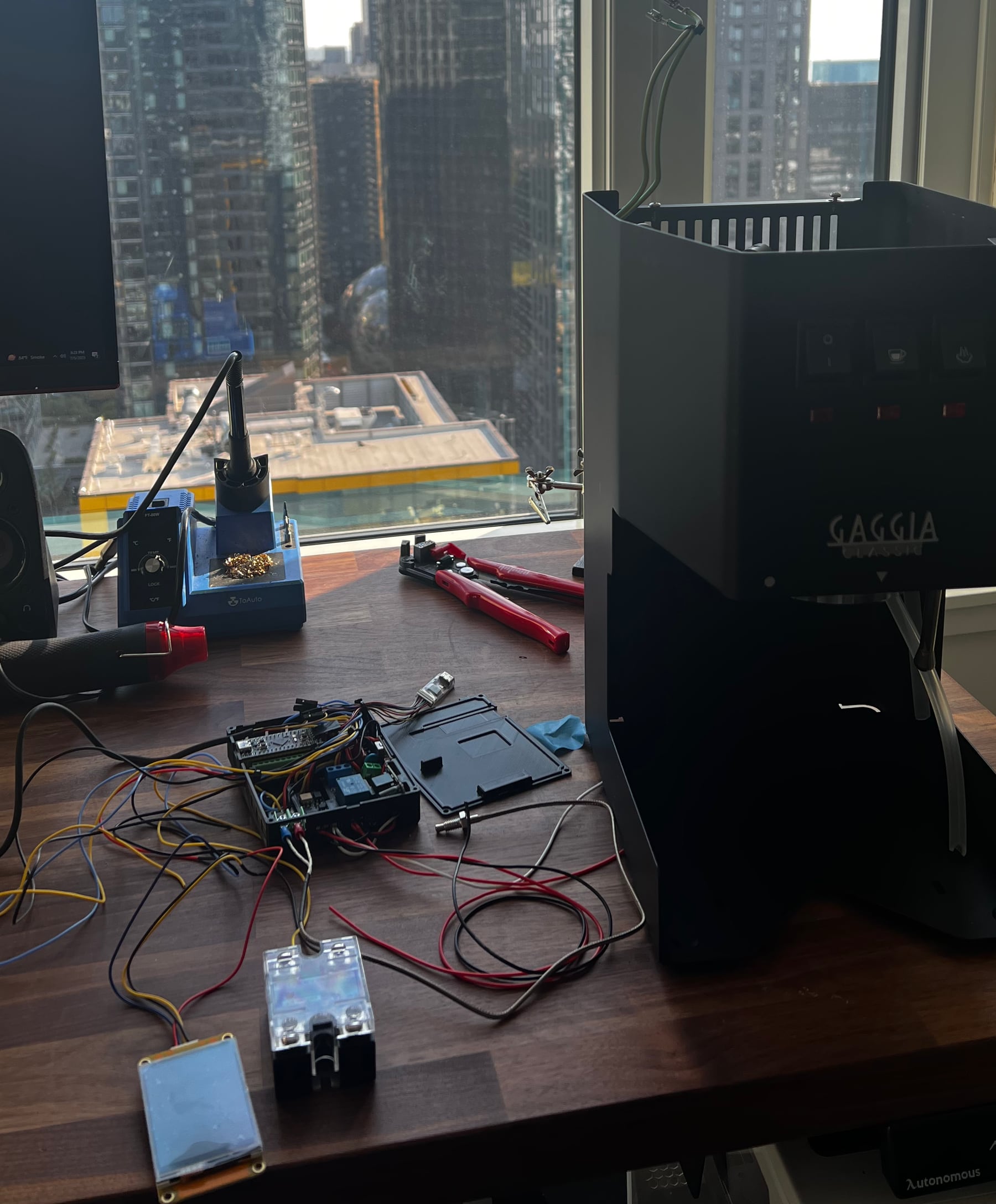
Our espresso machine is a Gaggia Classic Pro, about $600 out of the box, and it is a purely mechanical device. There’s no computer in it anywhere. A vibration pump pushes water through a fixed pressurestat, a bimetallic thermostat clicks the heater on and off around a rough temperature band, and that’s the entire control system: springs and metal, no sensors, no logic, no memory of what it did last time. It makes a fine shot if you already know what you’re doing and you’re willing to babysit it.
Gaggiuino is an open source project that rips that mechanical control loop out and replaces it with a microcontroller, a thermocouple, a pressure transducer, and a dimmer module wired between the pump and the wall. Instead of a thermostat guessing at temperature and a pressurestat guessing at pressure, you get real PID temp control, pressure profiling, and flow profiling, the same category of control you’d otherwise pay for in a machine that costs multiple thousands of dollars out of the box. Same $600 Gaggia on the outside, a completely different machine on the inside.
Why this is worth doing
A machine with actual shot profiling, meaning it can vary pressure and flow through the shot instead of just blasting a constant 9 bar, normally starts in the thousands of dollars. Gaggiuino gets you there for the cost of a handful of electronics parts and an afternoon of soldering. I ordered every part for this build from AliExpress for about $80 total.
The build
I’m using the Blackpill (STM32F411) as the microcontroller and the “Lego” build path rather than a custom PCB, meaning individual off-the-shelf modules wired together on stripboard instead of one purpose-made board. It’s more soldering and more wires, but it’s more forgiving to build and easier to debug one module at a time.
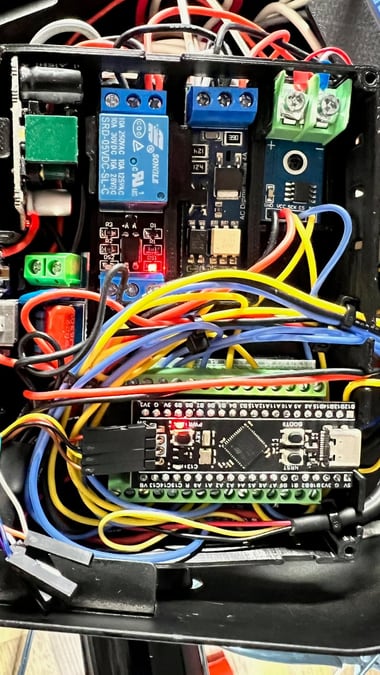
It’s supposed to be an evening of soldering. Mine took closer to 8 hours, and a good chunk of that was late-night debugging with the kitchen counter covered in loose wires and tubing. Chelsea was reasonably worried the mess wouldn’t come back together in time for coffee the next morning, which is a non-negotiable requirement at our house.
Shopping list
This is the Gaggiuino project’s own bill of materials for the STM32 Blackpill Lego build:
- Blackpill, STM32F411 25MHz HSE: the microcontroller that runs the Gaggiuino firmware.
- ST-Link V2: flashes the Blackpill.
- Arduino Nano expansion board: breaks the Blackpill’s pins out to screw terminals so nothing has to be soldered directly to it.
- ADS1115 ADC: reads the pressure transducer.
- Pressure transducer, 0-1.2MPa: measures brew pressure in real time.
- MAX6675 thermocouple module and a K-type thermocouple probe: reads boiler temperature.
- SSR-40DA solid state relay: switches the boiler heater under microcontroller control instead of a thermostat.
- RobotDYN dimmer module: varies the voltage going to the vibration pump, which is what actually makes pressure and flow profiling possible.
- Snubber: suppresses the electrical noise the dimmer and relay throw off, so the noise doesn’t corrupt the sensor readings.
- 12V/1A power supply and a 12V-to-5V step-down: power for everything above.
- 5V relay, stripboard, heat-resistant silicone wire, and spade connectors: the wiring itself.
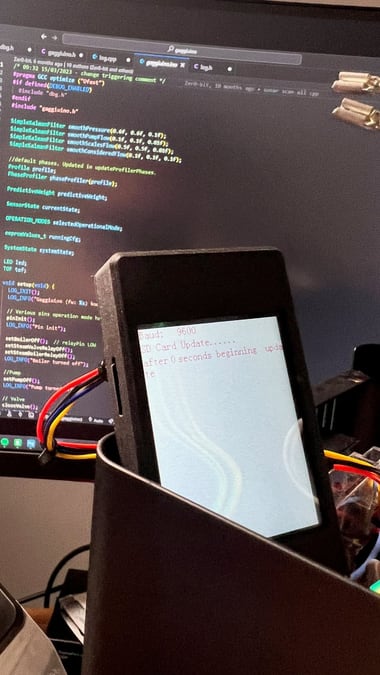
- 2.4” Nextion display and a microSD card: the on-machine screen for settings and shot graphs.
- 3D-printed component housing: everything above lives inside this instead of loose in the machine’s shell.
The full build guide, including exactly how each of these gets wired together, is in the Gaggiuino docs, and the firmware itself is on GitHub. Flashing the Blackpill itself takes seconds; the display gets its settings and shot graphs from a separate update over the microSD card.
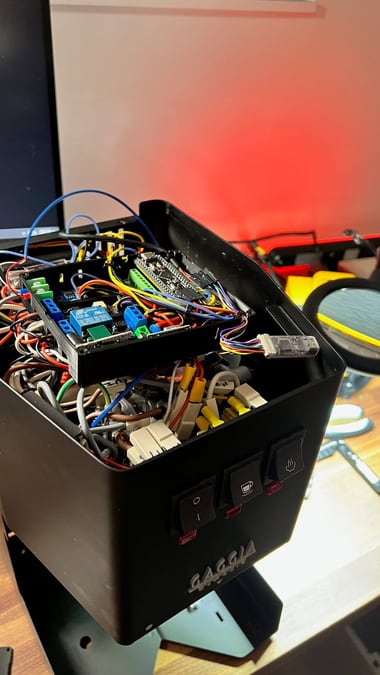
Everything above gets buttoned back into the Gaggia’s original shell, behind its original power, brew, and steam switches. From the outside it still looks like the same $600 machine. Everything that changed is on the inside.
The first test run, after all of that: pressure builds, the pump ramps through its profile, and the boiler holds temperature instead of cycling a thermostat on and off. That’s the whole point of the project working in front of me for the first time.
“Holy shit it works!?”
Integrating with our smart home
This isn’t a standalone gadget, it plugs into the same Home Assistant setup that runs the rest of the house. Gaggiuino exposes what it’s doing over the network, so Home Assistant can watch it and act on it the same way it watches everything else.
The plan for mornings: Home Assistant turns the machine on well before I’m actually awake, so by the time I’m pouring a shot the boiler is already at temperature and the portafilter’s metal has had time to warm and expand, along with the rest of the nerdy perks that only matter if you actually care about the shot. If I forget to turn it off, or I’m just not home to do it, it turns itself off after sitting on too long.
In practice the boiler doesn’t need the full runway to be usable. It settles into a stable temperature after 15 to 20 minutes, but a decent shot is pourable after about 5, just with a bit of temperature fluctuation still working itself out. It matters more for steaming: steaming pulls heat out of the boiler while it’s still fighting to hold temperature, so a boiler that hasn’t stabilized yet ends up with noticeably lower steam pressure right when you need it most.
It’s not just the morning schedule either. Home Assistant lets me warm the machine up or shut it off from anywhere in the house, or from my phone. Espresso machines take real time to get up to temperature, and it’s common for me to be in back-to-back Zoom meetings and want a coffee in the gap between them. I can click a button on my work laptop to boot the machine up mid-meeting, so it’s ready to pour a shot the moment I’m free.
From there the machine does the rest on its own. While I’m groggy and late for a meeting, I can start a shot and walk away: it auto-regulates temperature, pressure, flow, and time to pull the best shot it can, and stops itself the moment it hits the target volume, usually around 35 seconds, which is enough time for me to get my cup ready with vanilla or caramel syrup. It then auto-heats to steaming temperature and regulates the water pressure feeding the boiler to hold a much higher steam PSI than the machine could ever manage stock. Night and day difference.
What’s next
The Gaggia is cool, but I think we’ve surpassed it. We’d appreciate something more mechanically capable than what a modded Gaggia can ever be, Gaggiuino included. What I’d actually love is a Decent DE1. One day.